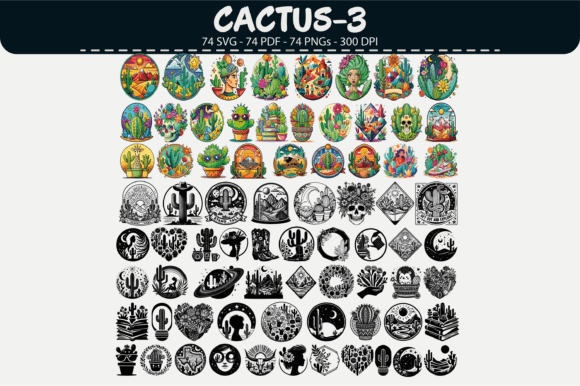
Cactus SVG Vector Clipart – 74 Designs: Graphics & Illustrations
As a blog designer who’s built over 200 editorial websites and published digital guides for brands, educators, and small business owners, I test every graphic design asset through the lens of real-world content performance—not just aesthetics. When Cactus SVG Vector Clipart – 74 Designs landed in my inbox, I opened it mid-edit on a lifestyle newsletter about sustainable home offices—and immediately paused. These aren’t generic clipart cacti. They’re clean, confident, and quietly versatile illustrations that land somewhere between modern design and warm editorial charm.
The first impression is one of intentional restraint: no excessive shading, no forced whimsy, no visual noise. The mood is calm but not clinical—playful without being childish, botanical without being academic. It leans into lifestyle, wellness, eco-conscious branding, creative entrepreneurship, and mindful education niches. Think “digital guide covers for plant-based meal planners,” “Pinterest pins for journaling prompts,” or “category thumbnails for a slow-living blog.” It reads as human-made, not AI-generated—precisely what readers subconsciously trust in editorial design.
Where does Cactus SVG Vector Clipart – 74 Designs shine in live publishing workflows? Everywhere visual clarity meets content intent. I used three variants last week to build a downloadable digital guide: one as a subtle watermark behind text-heavy worksheets (SVG transparency handled flawlessly), another resized and centered as a Pinterest pin header (crisp at 1000×1500 px), and a third layered into a Canva template for a newsletter banner—no pixelation, no alignment drift. Because these are true vector files, scaling from favicon size to full-width website header is seamless. And the included 300 DPI PNGs? Perfect for printable design use—think branded workbooks, media kits, or lead magnets meant for PDF download.
This pack supports stronger content performance in measurable ways. First impressions tighten: a well-placed cactus icon beside a headline signals topic relevance faster than text alone. Visual hierarchy improves when you use a bold silhouette as an article divider or a minimalist outline as a bullet accent. Click-through potential rises—especially on Pinterest, where botanical motifs consistently outperform generic icons in lifestyle and education categories. Brand identity gains consistency across touchpoints: same cactus style appears in your blog graphics, social media graphics, and digital product packaging. Reader trust deepens because polished visuals silently communicate care, credibility, and editorial intention.
Cactus SVG Vector Clipart – 74 Designs works best where attention needs gentle guidance—not forceful interruption. Hero images with soft gradient backgrounds? Ideal. Article thumbnails in grid layouts? Crisp and recognizable at small scale. Pinterest pins with overlay text? High-contrast variants hold up beautifully. Editorial accents—like section dividers or pull-quote borders—gain personality without distraction. Content upgrades like checklists or planning sheets feel more inviting with a single, thoughtful illustration. Newsletter headers gain warmth. Social media previews look cohesive across platforms.
Use it carefully in contexts demanding strict neutrality or high formality. Small mobile thumbnails under 80×80 px may lose detail in the most intricate designs—stick to bolder silhouettes there. Avoid pairing delicate line-art cacti with text-dense blog graphics; they’ll compete, not complement. Steer clear on low-contrast backgrounds (e.g., light green on mint) unless you manually adjust stroke weight or add subtle drop shadows. Busy layouts—think multi-column resource roundups—can overwhelm subtler variants. And while some designs carry quiet sophistication, this isn’t the pack for corporate law firm websites or enterprise SaaS dashboards. It’s not minimalism-for-minimalism’s-sake—it’s meaningful minimalism.
Here’s what I do before deploying any graphic design asset like Cactus SVG Vector Clipart – 74 Designs: test it in situ. I paste it into a real blog post draft—not a blank canvas—and preview on desktop, tablet, and iOS Safari. I check thumbnail rendering in my CMS. I layer headline text over it using my brand fonts: serif for editorial weight, sans serif for clean utility, script for lead magnet warmth, display fonts for eBook covers. I convert to grayscale to verify contrast integrity. I compress PNGs with Squoosh, keep SVGs raw (they’re tiny), and always confirm the commercial license permits use on monetized sites, affiliate marketing pages, and paid digital products. This isn’t just about legality—it’s about protecting your brand’s long-term visual equity.
What you get is a digital download packed with professional-grade assets: scalable SVG vectors for web design flexibility, print-ready 300 DPI PNGs for digital product and printable design use, and organized PDFs for quick reference—all in one ZIP. No physical item ships. No subscription. No hidden fees. Just 74 thoughtfully crafted illustrations ready to elevate your content marketing, strengthen your small business branding, and bring cohesion to your creative marketplace presence.
If you publish content that lives at the intersection of beauty and utility—if your readers expect both clarity and charm—Cactus SVG Vector Clipart – 74 Designs isn’t just decoration. It’s a functional part of your editorial toolkit. It helps your website header breathe, makes your social media graphics instantly recognizable, and turns everyday blog graphics into quiet moments of visual resonance. In a world saturated with generic stock art, these cacti stand tall—not as clichés, but as considered design assets with real publishing purpose.